Salatul Istikhara
Feeling Confused? ... Undecided?
It is natural that in our day-to-day affairs Muslims are confronted with important issues requiring decision making. This is sometimes accompanied by much thinking, anxiety and worry before one is able to decide one way or another, if at all! It is in regard to these types of situations that the Prophet Mohammed (pbuh) recommended a voluntary prayer for a person to employ which will enable him/her to seek from Allah (SWT) guidance in reaching the proper decision over a particular matter.
This is a prayer known in Arabic as Salatul Istikhara and its importance is such that Prophet Mohammad (pbuh) used to teach his companions about it the same way he used to teach them the verses of the Holy Qur'an. The companion Jabir (ra) said that the Prophet (pbuh) used to strongly encourage them to practice Istikhara for all their affairs. The manner of performing this prayer is that the person comes up with a voluntary prayer of two rakaats (units) at anytime during the day or night. Upon completing this prayer, the person then recites a private supplication in which is he/she seeks the guidance of Allah (SWT). This prayer is as follows:
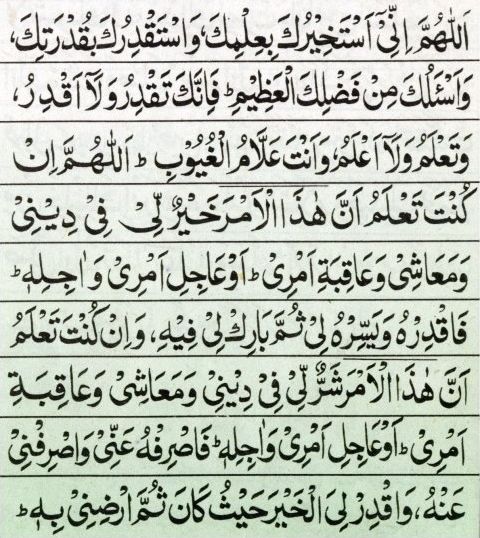
TRANSLITERATION:
‘Allahumma inni astakhiruka bi’ilmika, Wa astaqdiruka bi-qudratika, Wa asaluka min fadlika al-’azim Fa-innaka taqdiru Wala aqdiru, Wa ta’lamu Wala a’lamu, Wa anta ‘allamu l-ghuyub. Allahumma, in kunta ta’lam anna hadha-l-amra Khairun li fi dini wa ma’ashi wa’aqibati amri (or ‘ajili amri wa’ajilihi) Faqdirhu li wa yas-sirhu li thumma barik li Fihi, Wa in kunta ta’lamu anna hadha-lamra shar-run li fi dini wa ma’ashi wa’aqibati amri (or fi’ajili amri wa ajilihi) Fasrifhu anni was-rifni anhu. Waqdir li alkhaira haithu kana Thumma ardini bihi
ENGLISH TRANSLATION:
‘O Allah, I seek Your counsel by Your knowledge and by Your power I seek strength and I ask You from Your immense favour, for verily You are able while I am not and verily You know while I do not and You are the Knower of the unseen. O Allah, if You know this affair - and here he mentions his need- to be good for me in relation to my religion, my life, and end, then decree and facilitate it for me, and bless me with it, and if You know this affair to be ill for me towards my religion, my life, and end, then remove me from it, and decree for me what is good wherever it be and make me satisfied with such.’
And indeed, never would he regret who asks the Creator to choose for him, and consults with the creation, and ascertains his actions.
After seeking Allah's guidance as above, the person then resumes his/her routine affairs and waits for the due response from Allah. This can appear to the person by way of the feeling you have in your heart about the matter of either confidence or further indecision. Thus, when you feel in your heart a sense of vigor, optimism or confidence about the intended undertaking, you may construe this as a positive response from Allah (swt) and may accordingly proceed forward with the intended undertaking. If, on the other hand, the opposite is true and your sense of doubt or worries have not cleared, then you may want to avoid the proposed undertaking as it could mean a bad outcome.
Allah (swt) says:
...It is possible that ye dislike a thing which is good for you, and that ye may love a thing which is bad for you. But Allah knoweth and ye know not. (Qur'an 2:216)
Indeed the essence of this prayer is to test someone's trust in Allah, hence, the need to abide by the guidance of Allah whether it means pursuing or abandoning the intended undertaking. Allah also says:
...and if anyone puts his trust in Allah, sufficient is Allah for him. For verily Allah surely accomplishes His purpose: Verily, for all things has Allah appointed a due proportion. (Qur'an 65:3)